Reporting
You should not have to take our word for it.
Too often in this category, reporting means an invoice once a month. You get a weekly report against a standard you signed off, with live dashboard access rolling out to client teams.
Reporting and insights
See what your team did this week.
Every week you get a one page report on what your team did and how well they did it. Live dashboard access is rolling out to client teams.
-
Hours and output
Who worked, when, and what came out of it, on the same page.
-
Calls, tickets and tasks
What came in, what got done, and what is still open.
-
Quality scores
Reviewed work scored against the standard you signed off at the start.
-
Weekly trend
Whether this week beat last week, so a dip becomes a conversation before it becomes a problem.
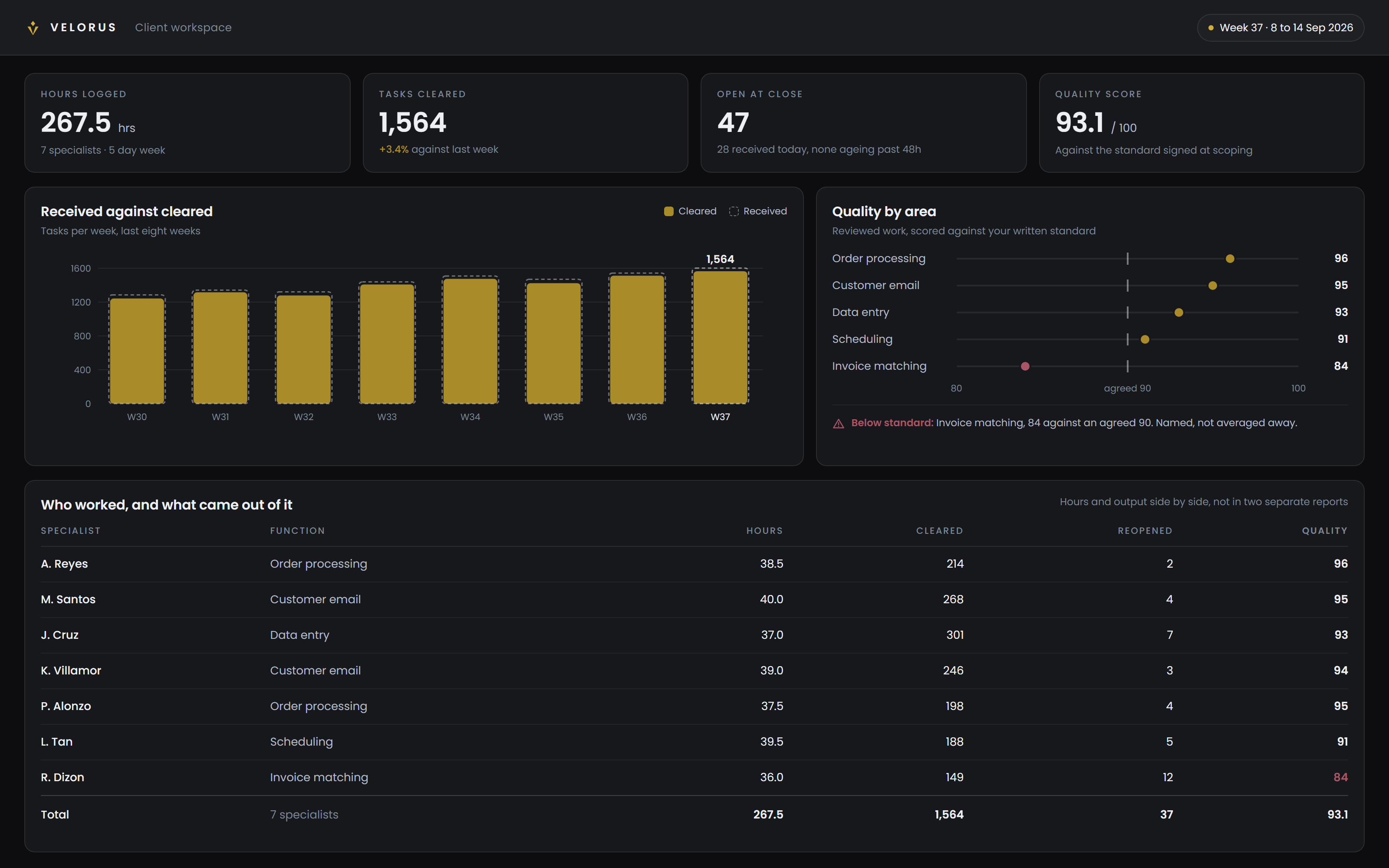
Every week
One page, in your inbox.
The weekly report is the version you can read in two minutes and forward to someone else. The dashboard, now rolling out, keeps the same numbers on screen between reports.
-
What the team produced
Volume handled, by person and in total, against what came in.
-
How it scored
Reviewed work measured against your written standard, with the misses named rather than averaged away.
-
What moved
This week against last week, so a trend is visible while it is still a trend.
-
What needs you
The short list of decisions only you can make. Everything else has already been handled.
Why it matters
Visibility is what makes accountability real.
A guarantee is only worth something if both sides can see the same facts. When performance is written down at scoping and measured in the open, a conversation about quality stops being a matter of impressions.
That is also why we can put a replacement commitment in writing. We are not guessing at how a team is doing, and neither are you.
How we stay accountable-
Scoping
The work, the volume, the tools, and what counts as done.
-
Written standard
Signed off by you before anyone starts.
-
Team works
Your phones, books or inbox, in your software, to that standard.
-
Manager scores
Reviewed work measured against the standard.
-
Weekly report
One page to you. Then the loop runs again.
If step 4 shows the standard is not being held
-
Replace the specialist
Within 10 business days, at no cost to you.
-
Credit the affected time
If no performing replacement is in place in that window.
Every week the team's work is scored against the standard you signed off. When a specialist falls short, the same facts trigger the replacement commitment.
Want to see it with your own work in it?
Send us the work and we will show you the team, the cost, and what your first weekly report would contain.